What Is SKAN? A Beginner’s Guide to Apple’s SKAdNetwork
If you’ve spent any time researching mobile app marketing, you’ve probably come across the terms SKAN or SKAdNetwork. Maybe a media buyer mentioned it during campaign setup. Perhaps your developer brought it up while implementing the Meta SDK. Or maybe you’ve seen it appear in the settings for Meta or TikTok Ads.
For many app founders, it’s one of those technical topics that sounds important—but isn’t always easy to understand.
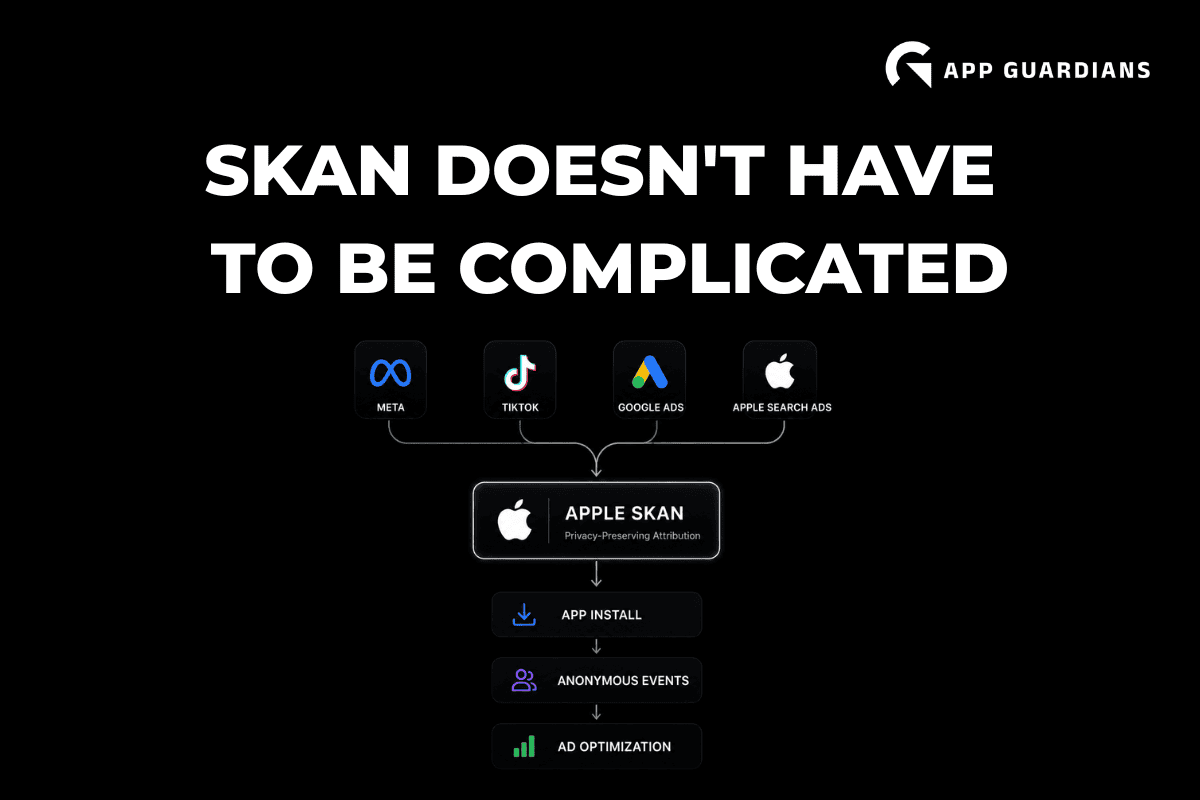
The reality is that SKAN affects almost every iOS app running paid advertising today. Whether you’re advertising on Meta, TikTok, Google Ads, or Apple Search Ads, understanding how SKAN works is now part of building successful user acquisition campaigns.
Fortunately, the concept is much simpler than it first appears.
What Is SKAdNetwork?
SKAdNetwork—commonly shortened to SKAN—is Apple’s privacy-focused attribution framework for iOS apps. Its job is to help advertising platforms understand whether an ad generated an app install or another important action, while protecting the privacy of individual users.
In the past, advertisers could see exactly which person clicked an ad, installed an app, and eventually became a paying customer. Today, Apple no longer allows that level of tracking for most users. Instead, SKAN reports campaign performance in an anonymous and aggregated way.
Think of it as Apple acting as a trusted middleman. Your app shares important conversion data with Apple, and Apple passes back enough information for advertising platforms to optimize campaigns—without revealing who the individual user is.
Why Did Apple Introduce SKAN?
The biggest reason was privacy.
In 2021, Apple introduced App Tracking Transparency (ATT) as part of iOS 14.5. This change required every app to ask users whether they wanted to allow tracking across apps and websites.
Many users chose to opt out.
That decision dramatically reduced advertisers’ access to Apple’s advertising identifier (IDFA), which had previously been the foundation of mobile attribution.
Apple recognized that developers still needed a way to measure advertising performance. SKAN became the solution—a framework that balances campaign measurement with user privacy.
Why Does SKAN Matter?
Every advertising platform relies on data to improve campaign performance.
When someone installs your app after seeing a Meta or TikTok advertisement, the platform wants to know whether that person became an engaged user or simply disappeared after installation.
Without that feedback, optimization becomes incredibly difficult.
SKAN provides enough information for advertising algorithms to continue learning, even though they can no longer identify individual users. It’s not perfect, but it’s become the standard for iOS attribution.
Installs Are Only the Beginning
One of the biggest misconceptions about attribution is that it’s only about measuring installs.
In reality, installs are just the first step.
The most valuable signals happen after someone downloads your app. Did they complete registration? Verify their email? Start a free trial? Make their first purchase? Subscribe?
Those events tell advertising platforms which users are actually valuable.
Imagine two campaigns. One generates 1,000 installs but only 20 subscribers. Another generates 700 installs but 150 subscribers. The second campaign is clearly creating more business value, even though it produced fewer installs.
That’s why modern app marketers focus on building strong post-install signals—not simply maximizing downloads.
How SKAN Fits Into Paid Advertising
Whenever someone installs your app after clicking an ad, several systems begin working together behind the scenes.
Your app logs important in-app events through an SDK. Apple processes that information using SKAN. Finally, advertising platforms such as Meta or TikTok receive anonymous conversion data that helps them improve future targeting.
While the process sounds technical, the goal is straightforward: help advertising algorithms find more people who behave like your best customers.
Where SDKs and Attribution Platforms Come In
SKAN doesn’t work on its own.
Your app still needs to send meaningful events, which is why SDKs and Mobile Measurement Partners (MMPs) remain such an important part of the attribution stack.
Many teams use platform-specific SDKs, including the Meta SDK or TikTok Events SDK. Others implement a dedicated MMP such as AppsFlyer, Adjust, Branch, Singular, or Kochava to manage attribution across multiple advertising channels.
The right solution depends on your business. An app advertising exclusively on Meta may not need a full MMP immediately. However, once you’re investing across multiple channels, centralized attribution becomes increasingly valuable.
Why Proper Attribution Matters
Launching paid campaigns without attribution is a little like driving with your dashboard covered.
You may still be moving, but you have no idea what’s actually happening.
Without accurate event tracking, advertising platforms struggle to identify high-quality users. Campaigns become less efficient, optimization slows down, and acquisition costs often increase.
On the other hand, a well-designed attribution setup gives advertising algorithms exactly what they need to improve over time. The stronger your event signals become, the smarter your campaigns become.
Common Attribution Mistakes
Many mobile apps begin spending on advertising before their measurement infrastructure is fully ready.
Some of the most common issues include:
- Missing SDK implementations
- Incorrect event mapping
- Weak post-install signal
- Missing subscription events
- Incomplete SKAN configuration
- Little or no testing before launch
Each of these issues limits the amount of feedback advertising platforms receive, making it much harder for campaign algorithms to optimize effectively.
How App Guardians Helps
At App Guardians, we believe attribution should be one of the first things established—not something fixed after campaigns begin.
Our team works alongside developers, product managers, and marketing teams to build the technical foundation required for successful paid acquisition. That includes selecting the right attribution solution, designing event taxonomies, implementing SDKs, validating SKAN readiness, testing event flows, and ensuring every important in-app action is measured correctly before marketing dollars are spent.
When the infrastructure is built correctly, every advertising platform has better data to learn from—and every marketing dollar works harder.
Final Thoughts
SKAN has fundamentally changed how mobile advertising works on iOS, but it hasn’t made paid acquisition impossible. It has simply made proper attribution more important than ever.
Teams that invest in strong event tracking, thoughtful SDK implementation, and a clear attribution strategy consistently outperform those that treat measurement as an afterthought.
If you’re preparing to launch paid campaigns for your app—or you’re unsure whether your current attribution setup is providing the signals your ad platforms need—our team can help you build a measurement framework that supports long-term growth.

Related Articles

Most mobile app teams spend countless hours designing onboarding flows, improving paywalls, and building new features. Far fewer [...]
Launching a mobile app today requires much more than building a great product and turning on paid ads. [...]
If you've spent any time researching mobile app marketing, you've probably come across the terms SKAN or SKAdNetwork. [...]