The Modern Mobile App GTM Tech Stack
Launching a mobile app today requires much more than building a great product and turning on paid ads.
The most successful app companies invest in the systems that measure user behavior, optimize marketing performance, and create sustainable growth from day one.
This collection of tools is commonly referred to as your Go-To-Market (GTM) tech stack.
Whether you’re preparing for launch or trying to scale an existing app, understanding the role of each system will help you make better decisions and avoid expensive mistakes.
What Is a Mobile App GTM Tech Stack?
A GTM tech stack is the collection of platforms that help you launch, measure, market, and grow your mobile app.
Each tool has a specific responsibility, but they all work together to create one connected growth ecosystem.
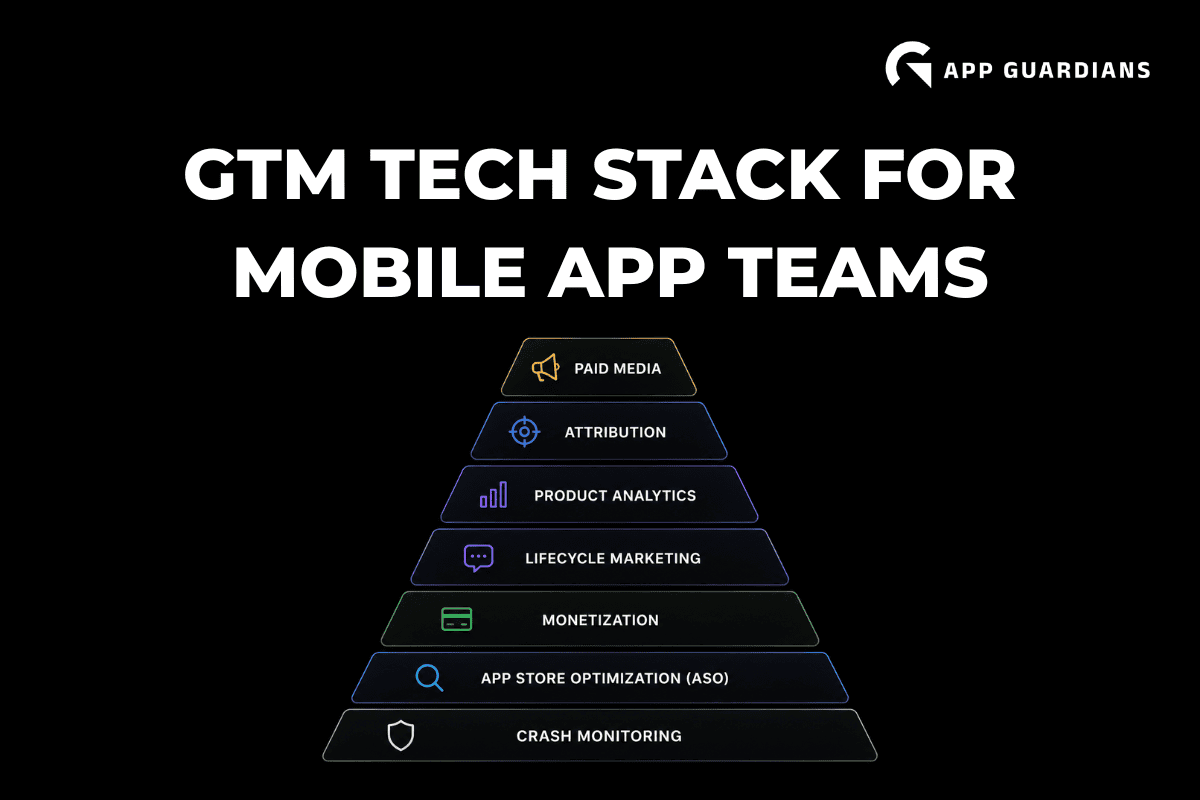
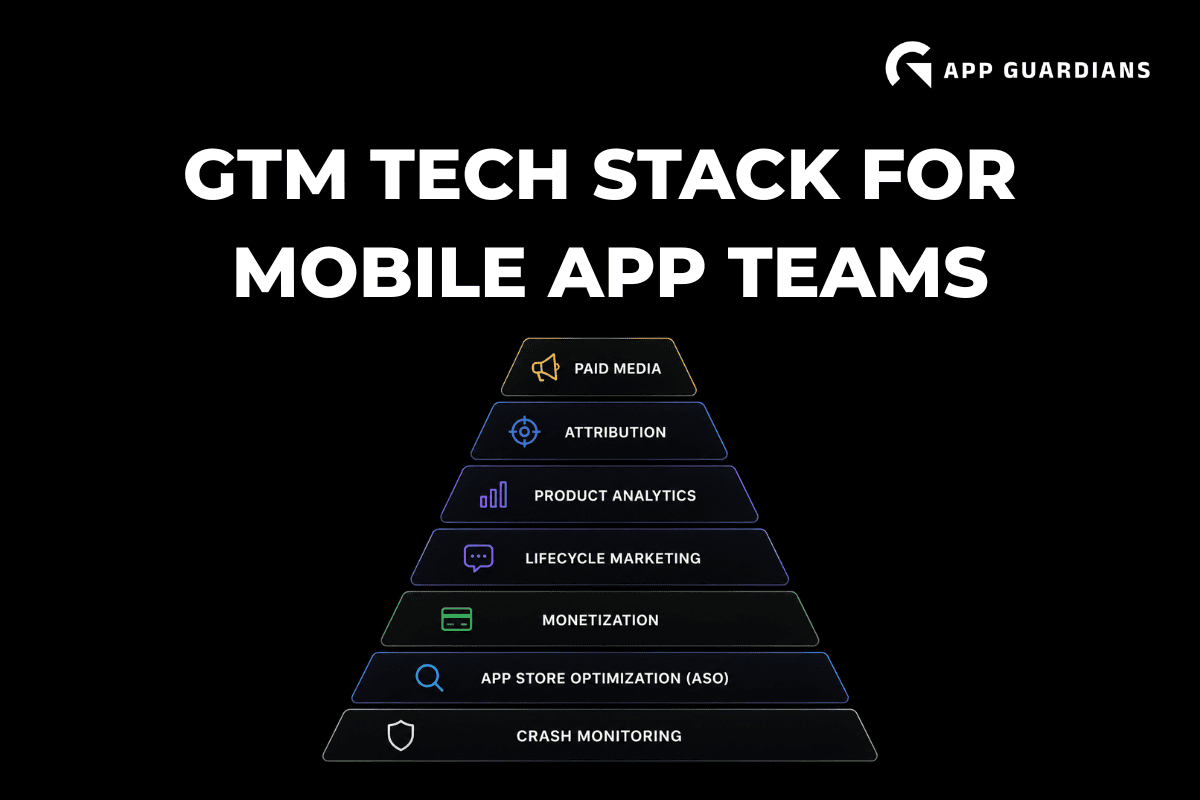
A modern app stack typically includes:
- Attribution (MMP)
- Product Analytics
- Lifecycle Marketing
- Monetization
- Paid Advertising Platforms
- App Store Optimization (ASO)
- Crash Monitoring
Together, these systems help you understand where users come from, what they do inside your app, and how to improve acquisition, retention, and revenue over time.
1. Attribution: Understanding Where Your Users Come From
Attribution platforms answer one simple but critical question:
Where did this user come from?
If someone installs your app after clicking a Meta ad, Apple Search Ads campaign, or TikTok video, your Mobile Measurement Partner (MMP) records that journey.
Popular attribution platforms include:
- AppsFlyer
- Adjust
- Branch
Without attribution, it’s impossible to accurately measure campaign performance or calculate return on ad spend (ROAS).
2. Product Analytics: Understanding User Behavior
Knowing where users come from is only half the picture.
Product analytics platforms help answer questions like:
- How many users complete onboarding?
- Where do users drop off?
- Which features are most popular?
- Which actions lead to higher retention?
Platforms such as Mixpanel, Amplitude, and Firebase allow teams to optimize the in-app experience using real user behavior instead of assumptions.
3. Lifecycle Marketing: Engaging Users Automatically
Not every user converts during their first session.
Lifecycle marketing platforms help you automatically communicate with users throughout their journey.
Examples include:
- Welcome push notifications
- Trial reminders
- Abandoned onboarding campaigns
- Re-engagement messages
Popular platforms include OneSignal and CleverTap.
These systems rely heavily on accurate user events to deliver the right message at the right time.
4. Monetization: Tracking Revenue and Subscriptions
Subscription apps need specialized tools to manage purchases, renewals, cancellations, and free trials.
Solutions like RevenueCat and Stripe simplify subscription management while generating valuable business events such as:
- Paywall viewed
- Trial started
- Subscription purchased
- Subscription cancelled
These events often become some of the most important optimization signals across your entire growth stack.
5. Paid Media Platforms: Optimizing Beyond Installs
Modern advertising platforms have become increasingly sophisticated.
Rather than optimizing only for installs, successful app companies gradually shift toward optimizing for deeper business outcomes, including:
- Completed onboarding
- Trial starts
- Subscription purchases
- High-value in-app actions
Platforms like Meta, TikTok, Google Ads, and Apple Search Ads perform best when they receive high-quality conversion signals.
That makes a well-designed measurement strategy essential before campaigns begin.
6. App Store Optimization (ASO): Improving Discoverability
Paid advertising drives traffic.
App Store Optimization helps convert that traffic into installs while increasing organic visibility over time.
ASO focuses on:
- Keyword strategy
- Metadata optimization
- Competitor analysis
- Screenshot optimization
- Conversion rate improvements
Popular ASO platforms include AppTweak and MobileAction.
For many apps, paid acquisition and ASO work together to improve both advertising efficiency and long-term growth.
Why Event Taxonomy Matters
Every interaction inside your app becomes an event.
Examples include:
- Account Created
- Onboarding Completed
- Workout Started
- Paywall Viewed
- Subscription Purchased
Together, these events create your event taxonomy—the structured framework that powers your entire growth stack.
A clean event taxonomy allows your attribution platform, analytics tools, lifecycle campaigns, advertising platforms, and monetization systems to work together using the same reliable data.
Without it, reporting becomes inconsistent, automation breaks down, and campaign optimization becomes far less effective.
How Everything Works Together
A modern mobile app doesn’t rely on one platform—it relies on all of them working together.
A typical user journey might look like this:
- A user installs your app after clicking a Meta ad.
- Your attribution platform records where the install came from.
- Your analytics platform tracks onboarding completion and what users are doing post download.
- Your subscription platform records a purchase.
- Your lifecycle platform sends personalized messaging to engage the users.
- Your advertising platforms receive conversion data to improve future campaign optimization.
This connected ecosystem allows every system to contribute to smarter marketing decisions.
Final Thoughts
Modern mobile app growth is no longer as simple as launching an app and running ads.
Successful app companies invest in the infrastructure that powers measurement, attribution, analytics, lifecycle marketing, monetization, and optimization from day one.
The earlier these systems are implemented correctly, the easier it becomes to scale efficiently, improve user quality, and maximize long-term return on investment.
At App Guardians, we help mobile app teams build the technical foundation and growth strategy needed to launch with confidence and scale sustainably.

Related Articles

Most mobile app teams spend countless hours designing onboarding flows, improving paywalls, and building new features. Far fewer [...]
Launching a mobile app today requires much more than building a great product and turning on paid ads. [...]
If you've spent any time researching mobile app marketing, you've probably come across the terms SKAN or SKAdNetwork. [...]