Attribution for Mobile Apps: The Beginner’s Guide to Building a Paid Growth Engine
Without attribution, you’re not running performance marketing. You’re simply paying for downloads and hoping for the best.
If you’re preparing to launch paid user acquisition for your mobile app, you’ve likely heard terms like attribution, mobile measurement partner, AppsFlyer, Branch, Meta SDK, SKAdNetwork, or event tracking thrown around.
For many founders, product teams, and marketers, attribution feels like a complicated developer problem.
In reality, it’s one of the most important foundations of successful app growth.
Before you spend your first dollar on Meta, TikTok, Apple Search Ads, Google App Campaigns, Reddit, or any other paid acquisition channel, you need to answer one simple question:
How will we know which marketing dollars actually produced valuable users?
That’s what attribution solves.
What is mobile app attribution?
At its simplest, attribution is the process of answering:
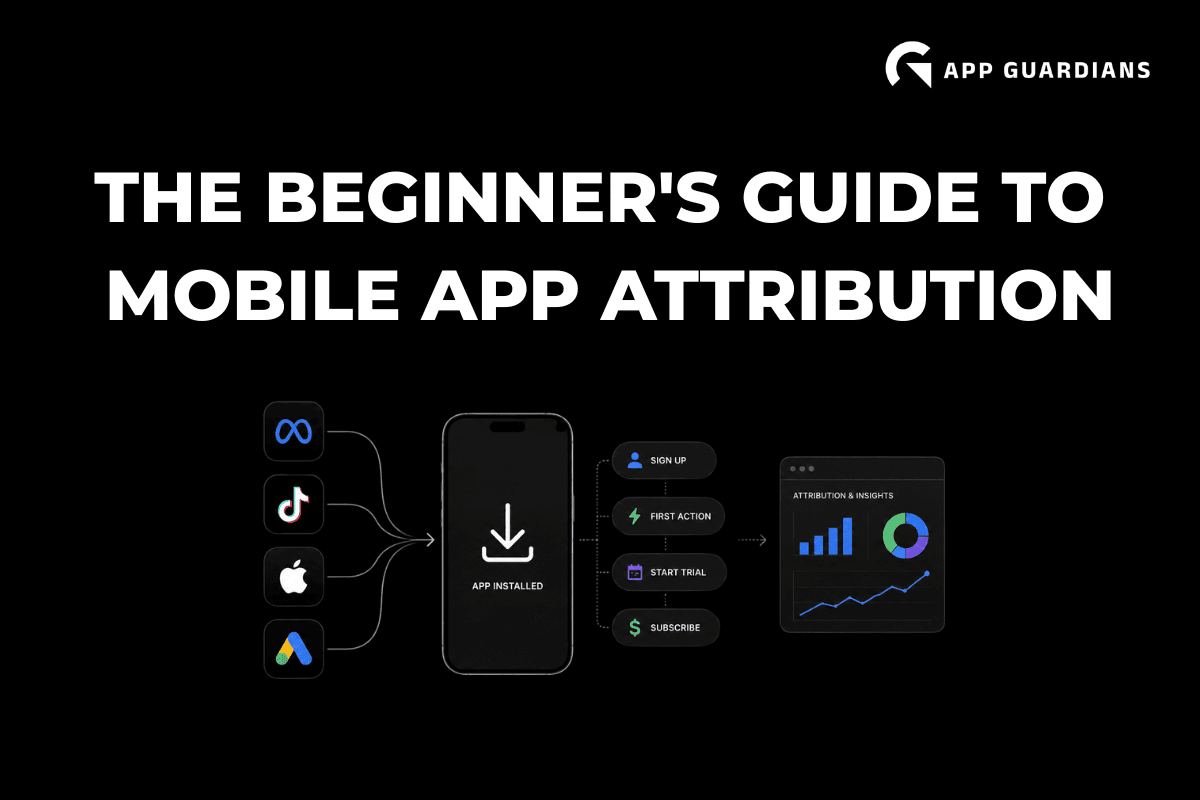
Which advertisement convinced this user to install our app—and what did they do after installing it?
Imagine someone:
- sees your Meta ad
- clicks it
- installs your app
- creates an account
- starts a free trial
- becomes a paying subscriber
Without attribution, all you know is:
“We got a new subscriber.”
With attribution, you know:
“This subscriber came from Meta Campaign A, Ad Set 3, Creative B.”
That changes everything.
Instead of guessing where your marketing budget is working, you can invest more in what’s producing revenue and eliminate what isn’t.
Attribution isn’t just about installs
This is one of the biggest misconceptions in mobile marketing.
Many founders think attribution exists only to measure installs.
Installs are actually one of the least interesting events.
What really matters is what happens after the install.
For example:
- App Installed
- Registration Completed
- Email Verified
- Onboarding Completed
- First Workout Logged
- First Meditation Started
- First Restaurant Saved
- First Loan Submitted
- First Ride Booked
- Subscription Trial Started
- Purchase Completed
- Annual Subscription Purchased
Those events tell advertising platforms who your best users actually are.
Why “signal” matters
One of the most important concepts in modern app marketing is signal.
Every event your app sends back to an advertising platform teaches its machine learning models something.
Think of Meta as training an incredibly sophisticated AI model.
Initially it knows almost nothing.
It knows:
- someone clicked
- someone installed
That isn’t enough.
As users continue interacting with your app, you’re feeding Meta higher-quality signals.
For example:
User A
- Installed
- Never opened app again
User B
- Installed
- Completed registration
- Started free trial
- Purchased annual plan
Those two installs should not be treated equally.
The second user is dramatically more valuable.
The more high-quality events you send back to Meta, TikTok, Google, or Apple Search Ads, the better those platforms become at finding more users who behave like User B.
That’s why we often say:
You’re not just buying installs. You’re training an algorithm.
The event hierarchy
A healthy attribution implementation usually follows a progression like this:
Basic
- Install
- App Open
Better
- Registration
- Email Verification
- Tutorial Completed
Even Better
- First Core Action
- First Workout
- First Lesson
- First Booking
- First Search
Best
- Start Trial
- Subscription
- Purchase
- Renewal
- Lifetime Value
Each additional event helps the advertising platform better understand your ideal customer.
How do advertising platforms receive these events?
This is where Software Development Kits (SDKs) come in.
An SDK is a small piece of code added to your mobile application that allows your app to communicate with external platforms.
For example:
Your app records:
- User completed registration
The SDK sends:
- Registration Complete
to Meta.
The same applies to:
- TikTok
- Apple Search Ads
- Snapchat
Depending on your setup.
Without these SDKs, the platforms can’t learn what users are actually doing inside your app.
There are two common ways to implement attribution
Option 1: Use a Mobile Measurement Partner (MMP)
A Mobile Measurement Partner acts as the central hub for attribution.
Instead of every advertising platform having its own independent implementation, the MMP receives your events and distributes them appropriately.
Industry-leading MMPs include:
- AppsFlyer
- Branch
- Adjust
- Singular
- Kochava
An MMP becomes the “source of truth” for your attribution.
Benefits include:
- Multi-channel attribution
- Fraud prevention
- Centralized event management
- Deep linking
- Cross-network reporting
- Easier scaling across advertising platforms
If you’re planning to advertise across multiple channels, an MMP is typically the preferred long-term solution.
Option 2: Use native platform SDKs
If you’re primarily advertising on a single platform—especially Meta—you may not need an MMP initially.
Meta’s native Facebook SDK is capable of:
- measuring installs
- logging in-app events
- optimizing campaigns
- building conversion signals
- reporting campaign performance
Many early-stage startups begin here because:
- implementation is simpler
- there are no MMP licensing costs
- setup can happen quickly
As companies scale into additional acquisition channels, they often migrate to an MMP.
There isn’t one “correct” answer.
The right choice depends on your growth stage, engineering resources, advertising mix, and reporting needs.
Attribution is only as good as your event strategy
Installing an SDK isn’t enough.
The bigger question is:
Which events should we send?
This is where many mobile teams struggle.
You could send hundreds of events.
You probably shouldn’t.
Instead, identify the events that truly represent user quality.
Examples include:
Fitness App
- Registration
- First Workout
- Third Workout
- Trial Started
- Subscription
Finance App
- Registration
- Bank Connected
- Payroll Connected
- Loan Submitted
- Paid Subscription
Meditation App
- Registration
- First Session
- Third Session
- Trial Started
- Subscription
Food Discovery App
- Registration
- Friend Added
- First Restaurant Saved
- First Review Posted
- Premium Subscription
Every app has different “quality signals.”
Finding them is one of the most valuable strategic exercises before launching paid acquisition.
Why this matters so much for Meta
Meta’s advertising algorithm is incredibly powerful.
But it isn’t magic.
It can only optimize toward the signals you provide.
If the only signal Meta receives is:
Install
it will find more people likely to install apps.
That doesn’t necessarily mean they’ll become customers.
If Meta instead receives:
- Registration
- Trial Started
- Subscription Purchased
it begins finding users who are much more likely to complete those actions.
That usually leads to:
- lower acquisition costs
- higher conversion rates
- better return on ad spend
- faster learning
- stronger scaling
Don’t wait until after launch
One of the biggest mistakes we see is teams launching paid campaigns first…
…and figuring out attribution later.
Unfortunately, every day without proper attribution means:
- incomplete data
- poor optimization
- wasted advertising budget
- slower algorithm learning
- difficult debugging
Attribution should be one of the first conversations—not one of the last.
Attribution is a collaboration, not just a development task
Successful attribution sits at the intersection of:
- Product
- Marketing
- Engineering
- Analytics
Developers understand the app.
Marketers understand the customer journey.
Growth teams understand the advertising algorithms.
All three perspectives are required to build a reliable measurement framework.
How we help mobile app teams
At our agency, attribution isn’t an afterthought.
It’s one of the very first systems we help clients build before spending meaningful advertising dollars.
Our process typically includes:
- auditing your existing attribution setup
- recommending the right measurement architecture (Meta SDK vs MMP)
- collaborating directly with your development team on SDK implementation
- creating a custom event taxonomy aligned to your product
- mapping in-app events to advertising platforms
- validating event quality before launch
- testing attribution and optimization events
- ensuring Meta, TikTok, Apple Search Ads, Google, and other platforms receive the signals they need to optimize effectively
Our goal isn’t simply to launch campaigns.
Our goal is to make sure every advertising dollar is measurable, attributable, and capable of teaching the platforms how to find more of your best customers.
Because without attribution, you’re not building a scalable growth engine.
You’re simply buying installs.
And those are two very different things.
Ready to build your attribution foundation?
Whether you’re launching your first paid acquisition campaign or scaling into multiple advertising channels, the quality of your attribution infrastructure will directly impact campaign performance.
If you’re unsure whether your SDK implementation, event taxonomy, or measurement setup is ready for launch, we’d be happy to review it with you.
Before spending another dollar on paid acquisition, make sure your attribution is built to support long-term growth.

Related Articles

Most mobile app teams spend countless hours designing onboarding flows, improving paywalls, and building new features. Far fewer [...]
Launching a mobile app today requires much more than building a great product and turning on paid ads. [...]
If you've spent any time researching mobile app marketing, you've probably come across the terms SKAN or SKAdNetwork. [...]